
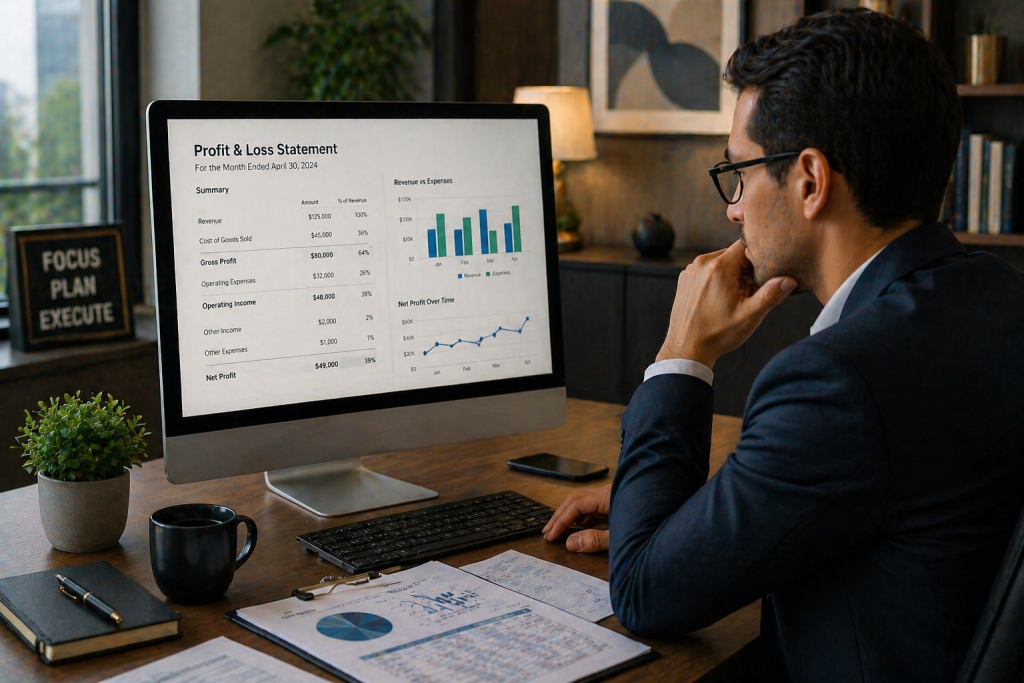
For many business owners, financial reports can feel overwhelming—especially when they include unfamiliar terms and structured formats.
One of the most important reports you will encounter is the Profit and Loss Statement (P&L).
Understanding how to read this report does not require an accounting background. With a basic framework, you can use it as a practical tool to better understand your business and make informed decisions.
What Is a Profit & Loss Statement?
A Profit and Loss Statement summarizes your business activity over a specific period of time.
It shows:
- Income (what your business earns)
- Expenses (what your business spends)
- Net profit or loss (the result)
This report helps answer a key question:
Is your business operating in a sustainable way?
Why This Report Matters
Your P&L is more than a document for tax purposes.
It helps you:
- Understand your financial performance
- Identify trends over time
- Evaluate whether your business is profitable
- Make more informed financial decisions
Without reviewing this report regularly, it becomes difficult to fully understand how your business is performing.
Breaking Down the Key Sections
1. Income (Revenue)
This section shows the total amount your business earned during the reporting period.
When reviewing income:
- Look for consistency over time
- Compare current periods to previous ones
- Identify any significant increases or decreases
Income provides insight into how your business is generating revenue.
2. Cost of Goods Sold (If Applicable)
For businesses that sell products, this section reflects the direct costs associated with producing or purchasing those goods.
Examples may include:
- Inventory costs
- Materials
- Direct labor (depending on the business type)
Subtracting these costs from revenue helps determine gross profit.
3. Gross Profit
Gross profit represents what remains after direct costs are subtracted from revenue.
This number helps you understand:
- Whether your pricing supports your costs
- How efficiently your business produces goods or services
4. Operating Expenses
These are the day-to-day costs of running your business.
Examples include:
- Rent
- Utilities
- Software subscriptions
- Marketing
- Professional services
When reviewing expenses:
- Look for patterns
- Identify areas that may need adjustment
- Ensure expenses align with your business goals
5. Net Profit (or Loss)
This is the final result after all income and expenses are accounted for.
It reflects:
- The overall performance of your business
- Whether your operations are sustainable
A positive number indicates profit, while a negative number indicates a loss.
How to Use Your P&L Effectively
Understanding the report is the first step—using it consistently is what creates value.
Consider:
- Reviewing your P&L monthly
- Comparing results across different periods
- Looking beyond totals to understand trends
- Using the report to guide business decisions
This turns your P&L into a tool for clarity, not just a report.
Common Mistakes to Avoid
- Reviewing your P&L only during tax season
- Focusing only on revenue instead of overall performance
- Ignoring expense trends
- Relying on outdated or incomplete data
Consistency and accuracy are key to making the report useful.
From a CPA Perspective
From a CPA standpoint, the Profit and Loss Statement is one of the most valuable tools for understanding a business.
However, its value depends on:
- Accurate bookkeeping
- Regular review
- Proper interpretation
When used correctly, it provides insight that supports both compliance and strategic decision-making.
Practical Steps to Get Started
- Review your most recent P&L report
- Focus on understanding each section individually
- Identify any areas that are unclear
- Begin reviewing your report on a consistent basis
- Consult with a CPA if you need guidance interpreting your numbers
Even a basic understanding can significantly improve your financial awareness.
Your Profit and Loss Statement is not just for accountants, it is a tool for business owners.
By understanding its structure and reviewing it regularly, you can gain valuable insight into your business and make more informed decisions.
Clarity in your financials leads to greater confidence in how you operate and grow your business.
If you would like help understanding your financial reports and using them to make better decisions, consider speaking with a licensed CPA.
Edith Alvarado, CPA – E.E. Accounting Solutions
Schedule a consultation to review your financial statements and reporting.