
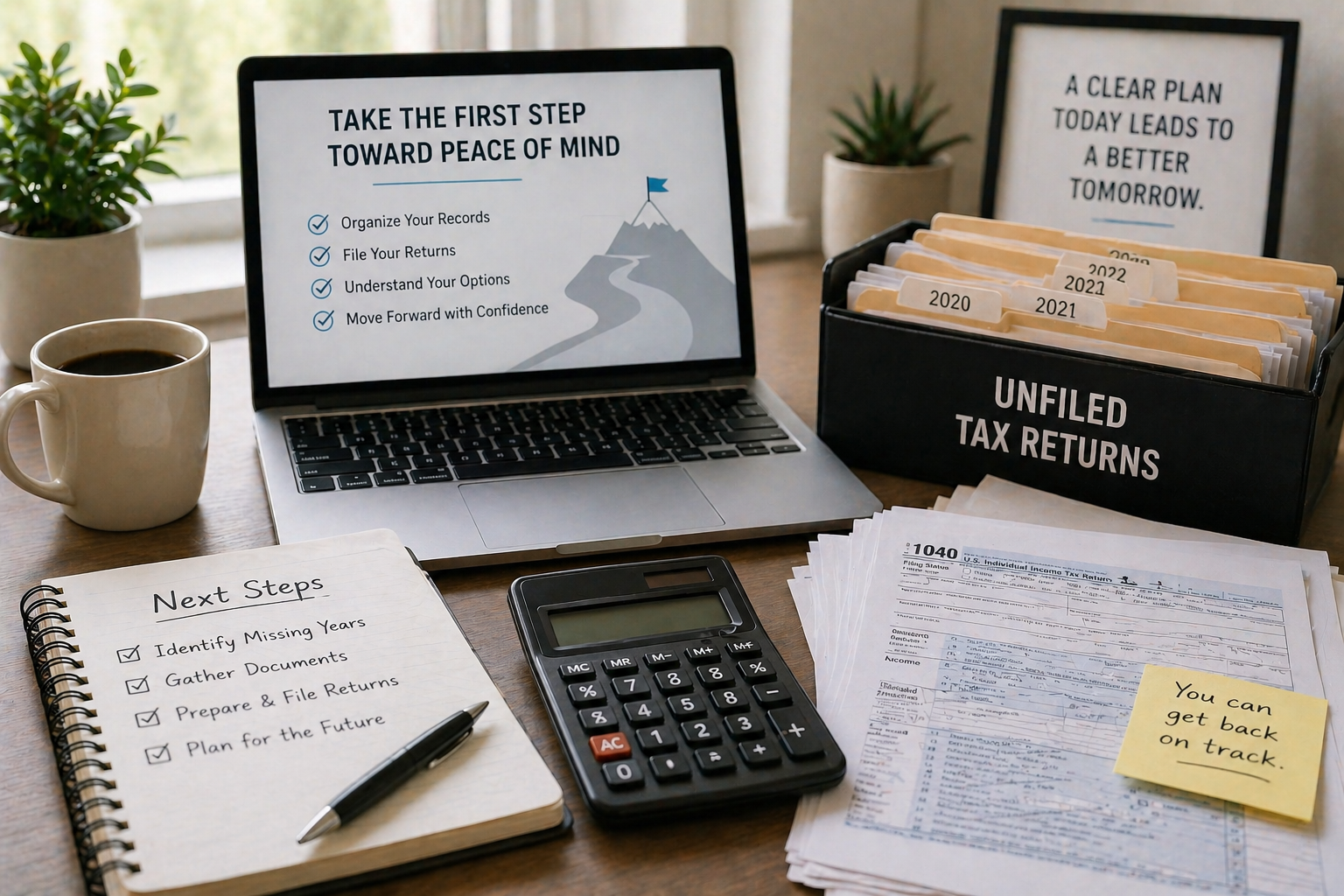
Changes in income, business responsibilities, or personal circumstances can make it difficult to stay current. Over time, this situation may begin to feel overwhelming, especially if multiple years are involved.
The important thing to understand is that there are structured ways to address unfilled tax returns, and taking a measured, informed approach can help you move forward with clarity.
Why Unfiled Taxes Should Be Addressed
When tax returns are not filed, it can create uncertainty around:
- Your actual tax obligations
- Your financial records
- Future planning and compliance
Addressing unfiled returns helps restore organization and allows you to regain a clearer financial position.
Common Reasons People Fall Behind
Many individuals and business owners fall behind for reasons such as:
- Uncertainty about how much is owed
- Disorganized financial records
- Changes in income or business structure
- Feeling overwhelmed by the process
These situations are more common than many people realize, and they can be addressed step by step.
A Structured Approach to Moving Forward
1. Determine Which Years Are Unfiled
The first step is identifying which tax years still need to be completed.
This creates a clear starting point and helps prioritize next steps.
2. Gather Financial Information
Collecting relevant documents is essential, including:
- Income records
- Expense documentation
- Prior tax filings (if available)
Even if records are incomplete, there are ways to begin organizing the information.
3. Reconstruct Records When Necessary
In situations where documentation is missing, it may be possible to reconstruct financial records using:
- Bank statements
- Payment histories
- Available reports
A structured approach helps rebuild the necessary information.
4. Prepare and File Returns
Once information is organized, returns can be prepared for the appropriate years.
Filing returns provides a clearer understanding of your actual tax position.
5. Evaluate Next Steps
After filing, it becomes easier to determine:
- Whether any balances are due
- What options may be available moving forward
- How to stay compliant going forward
From a CPA Perspective
From a CPA standpoint, the most important step is bringing clarity to the situation.
Rather than focusing on assumptions or uncertainty, a structured process allows you to:
- Understand your actual financial position
- Organize past records
- Move forward with a plan
Addressing unfiled taxes is not about rushing, it is about approaching the process correctly.
Practical Tips to Get Started
- Start by identifying missing tax years
- Gather whatever records you currently have
- Avoid delaying the process further
- Focus on organization rather than perfection
- Seek professional guidance if the situation feels unclear
Taking the first step often makes the process feel more manageable.
Falling behind on tax filings can feel complex, but it is a situation that can be addressed with the right approach.
By organizing your information and following a structured process, you can regain clarity and move forward with confidence.
Why Work With Edith Alvarado, CPA?
At E.E. Accounting Solutions LLC, the focus is on helping individuals and business owners address complex financial situations with clarity and professionalism.
Led by Edith Alvarado, CPA, services are designed to guide you through each step of the process.
- CPA-Led Professional Guidance
Your situation is reviewed with accuracy, care, and compliance in mind. - Structured and Organized Approach
Complex situations are handled step by step to reduce uncertainty. - Clear Communication
You receive straightforward explanations so you can understand your options. - Bilingual Service (English & Spanish)
Support is available in both languages.
Working with a CPA helps you move forward with a clear and organized plan.
If you have unfiled tax returns and would like to better understand your next steps, consider speaking with a licensed CPA.
Edith Alvarado, E.E Accounting Solutions Schedule a consultation to review your situation and develop a structured plan.